
Alert Forecasting & AI Insights
Shifting spike detection from reactive notification to proactive decision support — with forecasting and AI-powered insights.
Impact & Outcomes
Overview
Project
at a glance
Organisations rely on media monitoring tools to react quickly to changes in conversation volume. But traditional spike alerts are reactive — they notify users only after a spike occurs, limiting the ability to prepare. This project introduced forecasting into spike detection alerts, enabling users to anticipate upcoming surges in mentions and understand the drivers behind them through AI-generated insights. My role focused on designing the forecast visualisation model, alert experience, and insight interpretation layer to support faster decision-making.
The Problem
Users monitoring brand mentions faced three major challenges: reactive alerts that triggered after spikes occurred, leaving little time to respond; low confidence in trends, making it hard to judge whether a spike was meaningful or temporary; and a manual analysis burden requiring navigation across multiple dashboards to understand why a spike happened. This created significant friction for PR teams, marketers, and analysts who needed rapid situational awareness.
Forecast Visualisation
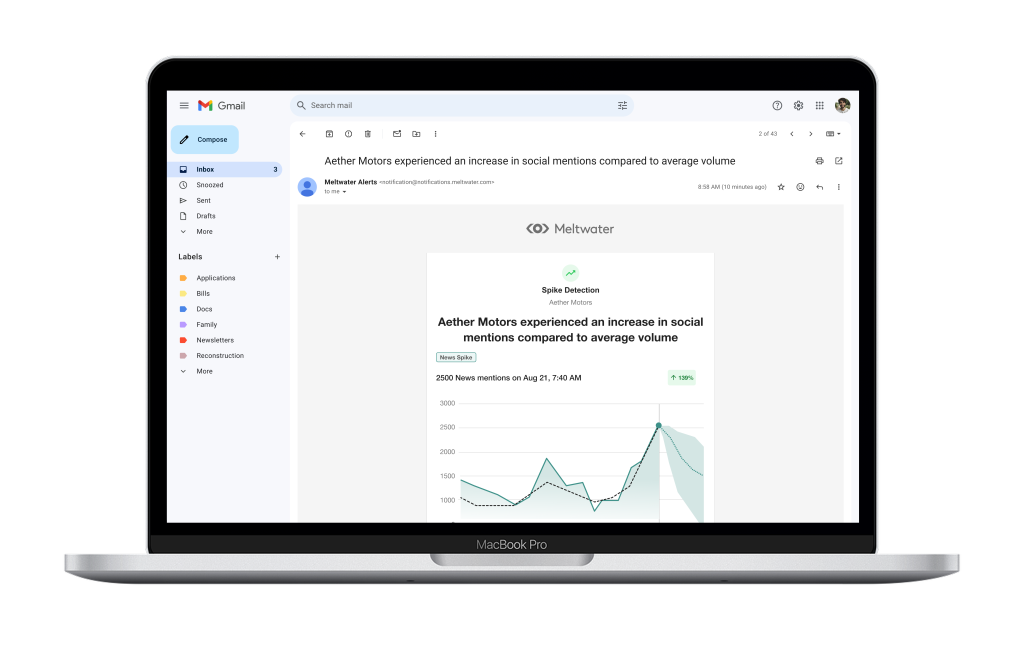
A predictive area was added to the chart showing expected mention volume beyond the current data point — including expected direction of conversation, potential spike severity, and a confidence range visualised as a shaded area. The visual language used: solid line for actual mentions, dashed line for trend baseline, shaded extension for forecast projection. For every 3 historical data points, the system generates 1 forecast point, producing a forward-looking trajectory that extends beyond real data. This separation prevented confusion between observed and predicted data.
AI Insights Layer
To eliminate manual analysis, we introduced automated contextual insights directly inside the alert — surfacing sentiment shifts, top drivers of conversation, emerging topics and keywords, source type changes, and geographic concentration. The goal was to answer the user's first question immediately: 'Why is this happening?' We also surfaced the most impactful content related to each spike, ranked by reach and engagement, reducing the need to open the platform for initial investigation.
Outcomes
Alert engagement rate increased by 28%, indicating users found alerts more relevant and actionable with predictive context and AI summaries. Time to user action after an alert decreased by 33%, as users could immediately understand what was happening without investigating multiple dashboards first. Click-through to the platform from email improved by 19%. Customer interviews and feedback indicated significantly higher trust in alerts — users reported feeling more prepared to respond to emerging trends and communicate insights to leadership.
I wanted to share feedback on the new AI summary in Alerts — this feature is amazing. I don't have to dig through data anymore and can react so much faster. This week we had an important spike, and I was able to flag it to my manager right before a presentation so we could adjust in time. It honestly made a huge difference.
Next case study
uWork
Mobile app helping self-employed tradespeople and small construction crews manage jobs end-to-end.